
How Search Engines Crawl, Index, and Rank Content in 2026: A Complete Guide
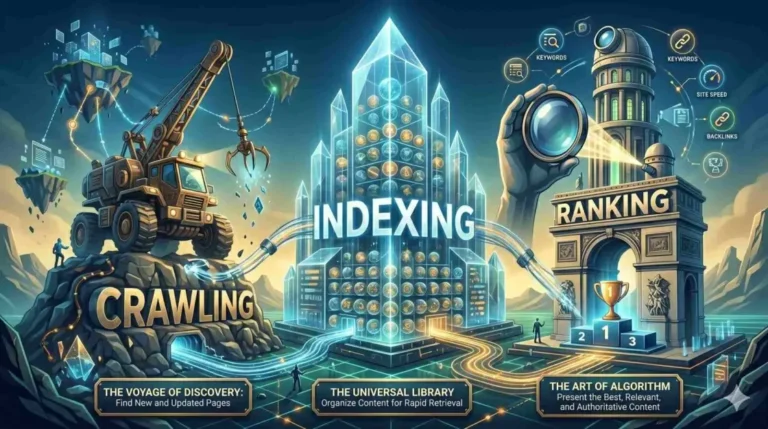
Have you ever wondered how search engines crawl index and rank content in 2026 to bring you the exact information you need in milliseconds?The internet is an ever-expanding digital wilderness, growing by millions of pages every single day. To the average user, finding a specific piece of information—whether it’s a vintage lasagna recipe or the latest quantum physics breakthrough—feels instantaneous. However, beneath the simple search bar lies one of the most complex engineering feats in human history.
Search engines do not “search the internet” in real-time when you type a query. Instead, they search a meticulously curated, categorized, and prioritized map of the web that they have spent years building. This process is governed by a tripartite architecture: Crawling, Indexing, and Ranking. Understanding this ecosystem is not just for developers; it is the cornerstone of modern digital literacy and marketing.
1. How Search Engines Crawl, Index, and Rank Content in 2026? Explained
Before a search engine can show you a website, it must first know the website exists. This discovery phase is known as Crawling.
The Mechanics of Spider
Search engines deploy automated software programs known as crawlers, spiders, or bots (such as Googlebot). These programs are the explorers of the digital age. They don’t just wander aimlessly; they follow a path of breadcrumbs—specifically, hyperlinks.
Crawling begins with a list of web addresses from past crawls and sitemaps provided by website owners. As a bot visits these websites, it uses the links on those pages to discover new URLs. This creates a chain reaction: one page leads to ten others, which lead to a hundred more, allowing the search engine to map out the interconnected “web” of the internet.
What is a Crawl Budget?
Search engines cannot crawl the entire internet every day; it would require infinite bandwidth and energy. Therefore, they operate on a Crawl Budget. Factors like how often a site updates, its server speed, and its perceived importance determine how frequently a bot visits.
Robots.txt: This is a small file on a server that acts as a “No Trespassing” sign or a “Guided Tour” map for bots, telling them which parts of a site to ignore.
Sitemaps: These are XML files that serve as a directory, explicitly telling the bot, “Here are the most important pages on my site.”
2. Understanding How Search Engines Index Content
Once a crawler finds a page, the search engine must make sense of it. This stage is Indexing. If crawling is the act of finding books in the world, indexing is the process of reading them, categorizing them, and placing them on a shelf in a library that spans the globe.
Processing and Analysis ( Why Indexing Matters for SEO in 2026 )
During indexing, the search engine parses the HTML code of a page to understand its content. It doesn’t just “see” text; it analyzes:
Textual Content: Keywords, headings, and semantic meaning.
Visual Media: Alt-text for images and video descriptions.
Meta Tags: Hidden snippets of code that describe the page’s purpose.
Key Signals: The location of the user the content is intended for, the language of the text, and the freshness of the information.
The “Big Table”
The result of this analysis is stored in the Index—a massive database housed in data centers across the world. When you perform a search, you are querying this index. To ensure speed, these databases are designed for “rapid retrieval.” Within milliseconds, a search engine can filter through trillions of pages to find the few thousand that match your specific words.
Canonicalization
Often, the same content appears on multiple URLs (for example, a mobile version and a desktop version). During indexing, the engine must decide which version is the “master” or Canonical version to avoid cluttering the index with duplicate information.
3. How to Help Search Engines Rank Your Content Higher
The final and most visible stage is Ranking. When a user enters a query, the search engine’s algorithm must decide the order in which to present the results. This is not a random selection; it is a sophisticated calculation involving hundreds of variables (signals) to determine which page provides the “best” answer.
User Intent vs. Keywords (Key Signals Used to Rank Tech Blogs)
Modern search engines, powered by AI like RankBrain or BERT, have moved beyond simple keyword matching. They now prioritize User Intent.
Informational Intent: “How does a solar panel work?”
Navigational Intent: “Login to Netflix.”
Transactional Intent: “Buy red running shoes size 10.”
The algorithm interprets the context of the search to ensure that if you search for “Mercury,” you get the planet if you’re a science student, or the element if you’re a chemist, based on your search history and surrounding terms.
4. The 3 Pillars: How Search Engines Crawl, Index, and Rank Content in 2026
To determine who gets the coveted “Position One” on the results page, algorithms weigh several core pillars of quality.
I. Relevance and Context
Relevance is the foundational requirement. The search engine looks for a match between the searcher’s query and the page’s topic. However, it also considers context:
Location: Searching for “pizza” in New York yields different results than in London.
Device: Some results are prioritized for mobile users (like maps and “click to call” buttons).
II. Expertise, Authoritativeness, and Trustworthiness (E-E-A-T)
Search engines want to provide reliable information, especially in sensitive areas like health or finance (often called “Your Money or Your Life” or YMYL topics).
Expertise: Is the creator of the content a subject matter expert?
Authoritativeness: Is the website a recognized leader in its field?
Trust: Is the site secure (HTTPS) and transparent about its authorship?
III. Technical Optimization and User Experience (UX)
A page with great information is useless if it takes a minute to load or is unreadable on a smartphone.
Core Web Vitals: These are metrics that measure loading speed, interactivity, and visual stability.
Mobile-Friendliness: Since the majority of global traffic is mobile, search engines use “mobile-first indexing,” meaning they primarily look at the mobile version of a site to determine its rank.
IV. Authority and Backlinks
In the early days of Google, the PageRank algorithm revolutionized search by treating links as “votes.” If a reputable site (like The New York Times) links to your blog, the search engine views this as a massive vote of confidence. This “link equity” or “authority” remains one of the most powerful ranking signals today.
5. Enhancing the Result: Structured Data
To bridge the gap between human language and machine understanding, developers use Structured Data (or Schema Markup). This is a standardized format for providing information about a page and classifying the page content.
By using Schema, a website can tell a search engine: “This isn’t just text; it’s a five-star review,” or “This is the date of a concert.” This allows search engines to create Rich Snippets, which are enhanced search results that include:
Star ratings.
Price ranges for products.
Ingredient lists for recipes.
FAQ dropdowns.
These snippets don’t necessarily improve “rank” directly, but they significantly increase the likelihood that a user will click on the result because it provides immediate value.
6. The Evolution: From Strings to Things
We are currently moving from a world of “strings” (matching sequences of characters) to a world of “things” (understanding entities and relationships). This is often called the Knowledge Graph. Search engines now understand that “Leonardo da Vinci” is a person who painted the “Mona Lisa,” which is located in the “Louvre.”
This interconnected understanding allows for:
Direct Answers: Providing the answer in a box at the top of the page so the user doesn’t even have to click.
Voice Search: Enabling conversational queries via AI assistants.
Visual Search: Allowing users to take a photo of an object to find it online.
Conclusion: The Symbiosis of Content and Code
The journey from a bot discovering a URL to a user clicking a top-ranked result is a cycle of constant evaluation. Search engines are not static; their algorithms are updated thousands of times a year to combat spam, prioritize high-quality journalism, and adapt to changing human behavior.
For creators, the “secret sauce” of ranking is no longer about “tricking” the bot with hidden keywords or artificial links. Instead, the modern search landscape rewards those who create human-centric content that is technically accessible, demonstrably authoritative, and deeply relevant to the user’s needs. In the end, the search engine’s goal is simple: to be the most helpful librarian in the history of the world.
Frequently Asked Questions (FAQ)
1. What is the difference between crawling and indexing?
Crawling is the act of finding a website by following links, while indexing is the process of understanding and saving that page into the search engine’s database.
2. How search engines crawl and index?
Crawling is the act of finding a website by following links, while indexing is the process of understanding and saving that page into the search engine’s database.
2. How long does it take for a search engine to rank my content?
It varies from a few days to several months. It depends on your site’s authority, how quickly bots crawl your pages, and the competitiveness of your keywords.
3. Can a page be indexed but not ranked?
Yes. A page can be stored in the database (indexed) but may not appear on the first few pages of results if the algorithm deems it low-quality or irrelevant to the user’s search.
4. Does social media activity help with ranking?
Social media shares are not a direct ranking factor, but they increase visibility, which leads to more backlinks—and backlinks are a major ranking signal.
5. Why did my page drop in the rankings?
Common reasons include new competitors publishing better content, a technical error on your site (like slow speed), or a search engine algorithm update.
Over to You! ❤️
“I really appreciate you taking the time to read this blog. Your thoughts and feedback mean a lot to me, so I’d love to know your opinion in the comments!” Drop your thoughts in the comments.
 Share this post with your tech-loving friends.
 Follow us for more future tech insights.

About the Author
Hi, I’m VIJAY WASNIK, the founder of Factechno.com. Like many aspiring webmasters, I balance a busy professional work schedule while building digital assets in my spare time. My mission with Factechno is simple: to document hands-on SEO experiments, Google Search Console troubleshooting, and Artificial Intelligence —cutting through theory to show what genuinely works for solo creators.