
ChatGPT: The Night the Internet Got a New Best Friend
On November 30, 2022, at 7:38 p.m. UTC, OpenAI flipped a switch and the internet got a new best friend.
The product had a boring name—ChatGPT—but the experience felt like magic. You typed a sentence. It replied in full paragraphs. It cracked jokes. It apologized. It wrote code. It drafted emails.
Within five days, a million people had signed up. Within two months, estimates put monthly active users around 100 million. It was the fastest “wait, everyone’s using this” moment in recent tech history.
This is the story of how a research preview became a cultural phenomenon, how it got smarter and more controversial, and where it stands now. It’s also a story about us—how we laughed, panicked, learned, and slowly stopped treating AI like a carnival trick and started treating it like a tool.
The Setup: GPT-1, GPT-2, GPT-3
ChatGPT didn’t arrive from nowhere. It stood on a ladder of models OpenAI had been building since 2018.
GPT-1
GPT-1 (2018) was modest. It could predict the next word in a sentence and showed that scaling up data and parameters could improve language understanding.
GPT-2
GPT-2 (2019) shocked people. It wrote coherent news-style articles and blog posts. OpenAI initially held back the full release over fears of misuse, a rare “we built it, but maybe we shouldn’t unleash it yet” moment.
GPT-3
GPT-3 (2020) went viral in developer circles. With 175 billion parameters and training on a huge slice of the internet, it could generate code, marketing copy, stories, and sometimes confidently wrong answers. It felt like talking to a very well-read friend who occasionally makes things up.
By late 2022, OpenAI had refined these ideas into the GPT-3.5 series—better at following instructions, safer, and more consistent. ChatGPT was the friendly chat interface wrapped around this engine.
What can chatgpt do for us ?
It is a very capable digital assistant that understand and generate text for you.
Some tasks that chatgpt does are given below :
Respond to queries
Regarding history, science, technology, geography etc.
Explains and define particular topics.
Generate codes in almost any computer language within a minute.
Solve mathematical and logical problems.
Assist in writing
Write an essay, blogs, poems, stories, riddles, short notes, headings, paragraphs and so on.
Edit, correct and rephrase writing.
Generate resumes, drafts and cover letter.
Translate text to different languages.
Assist in Learning
Explains concepts in simple terms.
Preparation for exams.
Create flash cards and summaries.
Create your plan and schedule for study.
Generate computer programming codes
Write and debug codes in c, c++, java and so on.
Provide suggestions to improve your coding skills.
Assist in learning programming languages like c, c++, java, python etc.
Creative work
Ideas for blogging, youtube channels, digital marketing.
Write dialogs, lyrics, stories etc.
By looking at the above points any girls can fall in love with chatgpt.
But wait ! if you are looking for a friend then you should find someone like me who sees, listen to you, talk to you, sympathies you and support you.
No need to get imotional with an AI, afterall its just a machine which seems real.
Lets understand what chatgpt cannot do?
Clearly, it cannot fetch a pale of water for you from the well.
It has certain limitations and boundaries.
Let’s discuss
- No access to private information
- chatgpt is not designed to keep private information of the people.
- Can’t access companies private database.
- Doesn’t know your location, email or password.
- Can’t provide medical and legal advise because its not a doctor. Only doctor can examine you and diagnose the illness and give proper treatment.
- Not a legal adviser because for that you will require a qualified lawyer.
- No feelings like human beings. Its a machine based on AI designed to help people in their everyday work.
- No conciousness.
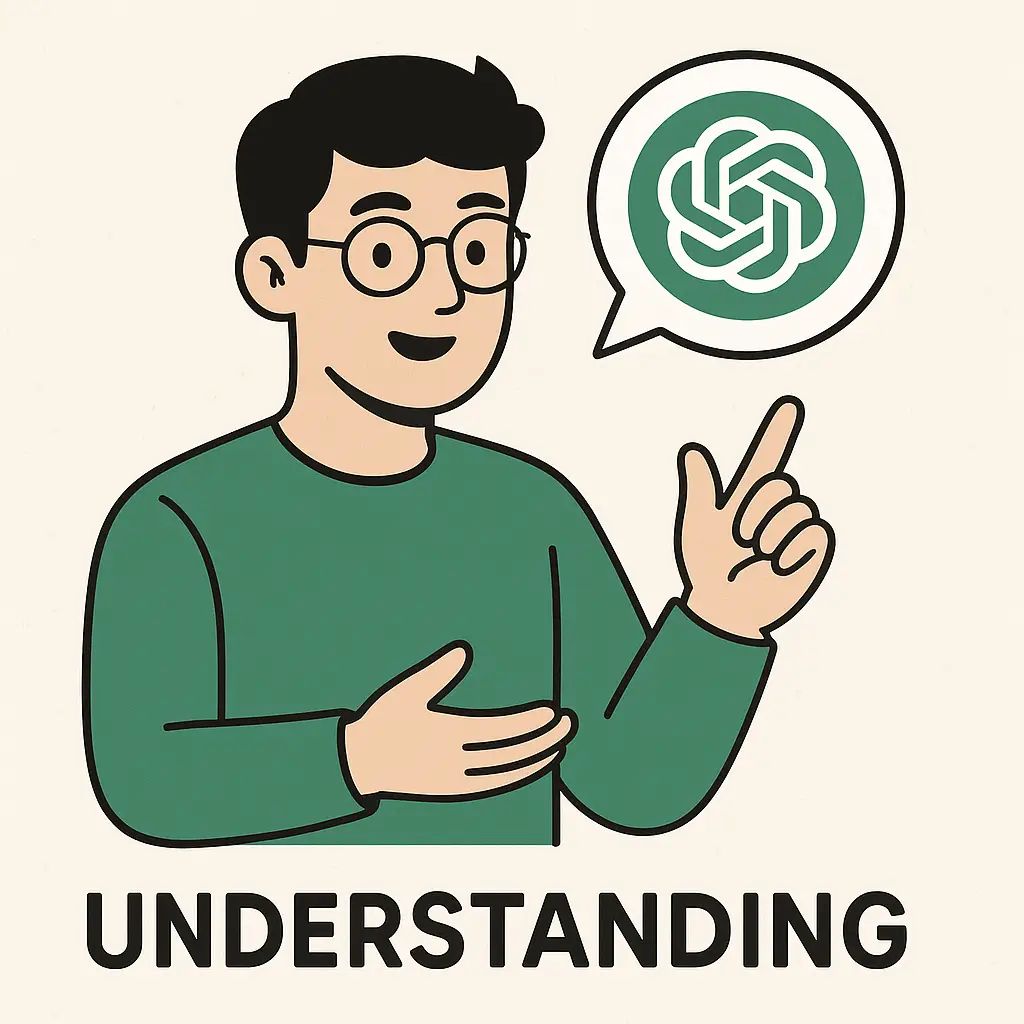
How to understand chatgpt ?
Understanding chatgpt is easier when you know how it works and how to communicate clearly with it. Here’s a simple guide:
What is chatgpt?
Chatgpt is a AI chatbot developed by OpenAI. It can:
- Answer questions
- Assist with writing(emails, essays, codes, ets.)
- Explain things simply
- Chat casually
How to use Chatgpt well?
- Be Clear and Specific say exactly what you need.
- Wrong ” Tell me something”
- Correct “Explain Polymorphism in simple english”
- Ask Follow-Up Questions
- You an keep asking questions. It remembers the context of your chat.
- Give Examples If You’re Stuck
If you don’t know how to ask. give an example.- correct “I want to write message like: ‘I’m late for work because of traffic.’ Can you make it more polite?”
- Use simple English
You don’t have to use words. Chatgpt understands basic sentences too.
What can you ask ?
- Daily help: “What’s a healthy breakfast?”
- Learning English: “What is the difference between ‘between’ and ‘among’?”
- Writing help: “Can you help me to write blog.
- Translation: “Translate ‘See you again’ into russian.”
Tips for Better Understanding
- If something is confusing, say:
- “Can you explain it more simply?”
- If the answer is too long, say:
- “Summarize it for me.”
- If it not what you wanted, say:
- “That’s not what i meant. I meant this…”
Areas of application
Application Areas
- Education
- Writing
- Work
- Coding
- Daily Life
- Personal Growth
Examples
- Homework, language learning
- Emails, Blogs, Creative writing
- Resume, reports, Presentation
- Debug code, write functions
- Recipes, Travel tips, Budgeting
- Conversation, Wellness, Planning
Learning AI (Artificial Intelligence)
Learning AI (Artificial Intelligence) is important for several powerful reasons:
1. Future-Proof Your Career
AI is transforming every industry—from healthcare and finance to agriculture and entertainment. Knowing AI gives you a competitive edge and opens up many job opportunities in a growing field.
2. Solve Real-World Problems
AI helps solve complex problems like diagnosing diseases, predicting natural disasters, improving education, and making transportation safer. Learning AI means you can contribute to these impactful solutions.
3. Boost Productivity and Efficiency
AI automates repetitive tasks and processes data much faster than humans can. If you understand AI, you can create smarter tools that save time and money in any domain.
4. Enhance Creativity and Innovation
AI is not just technical—it’s creative. Artists, designers, and writers use AI to generate new ideas, music, and art. Understanding how it works helps you use it more effectively.
5. Understand and Shape the Future
AI will influence laws, ethics, and global decision-making. Learning it helps you become not just a user, but someone who can guide how it’s used responsibly.
Here's a step-by-step guide to start learning AI, even if you're a beginner:
Step 1: Understand the Basics
Start with the foundational concepts:
What is AI?
Difference between AI, Machine Learning (ML), and Deep Learning (DL)
Real-life applications of AI
Recommended Resources:
YouTube: “What is Artificial Intelligence?” by CrashCourse or Simplilearn
Book: AI Superpowers by Kai-Fu Lee (simple and inspiring)
Step 2: Learn Python Programming
Python is the most popular language for AI.
Focus on:
Variables, loops, functions
Data structures (lists, dictionaries)
Basic libraries: numpy, pandas
Where to Learn:
W3Schools Python Tutorial
Codecademy – Python
Step 3: Learn Math for AI (Just the Essentials)
You don’t need to be a math expert—just focus on:
Linear Algebra (vectors, matrices)
Probability & Statistics (mean, variance, probability rules)
Calculus basics (derivatives, especially for optimization)
Try:
Khan Academy’s Linear Algebra
3Blue1Brown’s YouTube channel for visual explanations
Step 4: Learn Machine Learning
Start building basic models:
Regression
Classification
Clustering
Courses:
Coursera: Andrew Ng’s ML Course (top-rated)
Google’s ML Crash Course
Step 5: Practice with Projects
Build simple real-world AI apps:
Predict house prices
Handwriting recognition
Chatbot
Movie recommendation system
Tools to use:
Jupyter Notebook
Google Colab (free & cloud-based)
Step 6: Explore Deep Learning
Once you’re comfortable with ML:
Learn about Neural Networks, CNNs, RNNs
Use libraries like TensorFlow or PyTorch
Also checkout –
Conclusion
Chatgpt is a remarkable example of how far artificial intelligence has come in transforming the way we communicate and work. From assisting with writing and research to offering support and inspiration, it’s proving to be a valuable companion in various aspects of life. As AI technology continues to grow, chatgpt is paving the way for a future where human-AI collaboration becomes an everyday reality.
[…] chatGPT – A compassionate honest buddy or fatal enemy. […]